 Hassan Maishera

Binance has launched Agent OS, a standardized developer platform designed to connect artificial intelligence applications with its financial infrastructure.
In a press release shared with Cryptowisser, Binance said the platform gives developers, quantitative trading teams, and fintech companies a common access layer for Binance’s trading, market data, wallet, payment, and on-chain capabilities across cryptocurrency and traditional markets.
Agent OS forms part of Binance Intelligence, the exchange’s broader initiative for developing AI-powered products and user experiences.
Agent OS Connects AI Applications to Binance
Agent OS provides a controlled foundation for building financial applications and autonomous agents capable of interacting with Binance products.
The platform supports ready-made integrations alongside AI agents developed by users and external teams.
Through compatible tools such as ChatGPT, Claude Code, Codex, and Cursor, users can grant agents permission to retrieve market data, review account information, and perform supported trading activities.
Access remains subject to the limits and permissions selected by the user.
Binance Vice President of Product Jeff Li said the platform aims to address the fragmented infrastructure developers encounter when building agentic financial applications.
“Binance Agent OS addresses the fragmentation developers face when building agentic finance applications across crypto and traditional markets,” Li said.
He added that the platform gives developers and quantitative traders access to reliable data, low-latency infrastructure, and standardized interfaces for deploying AI-driven strategies.
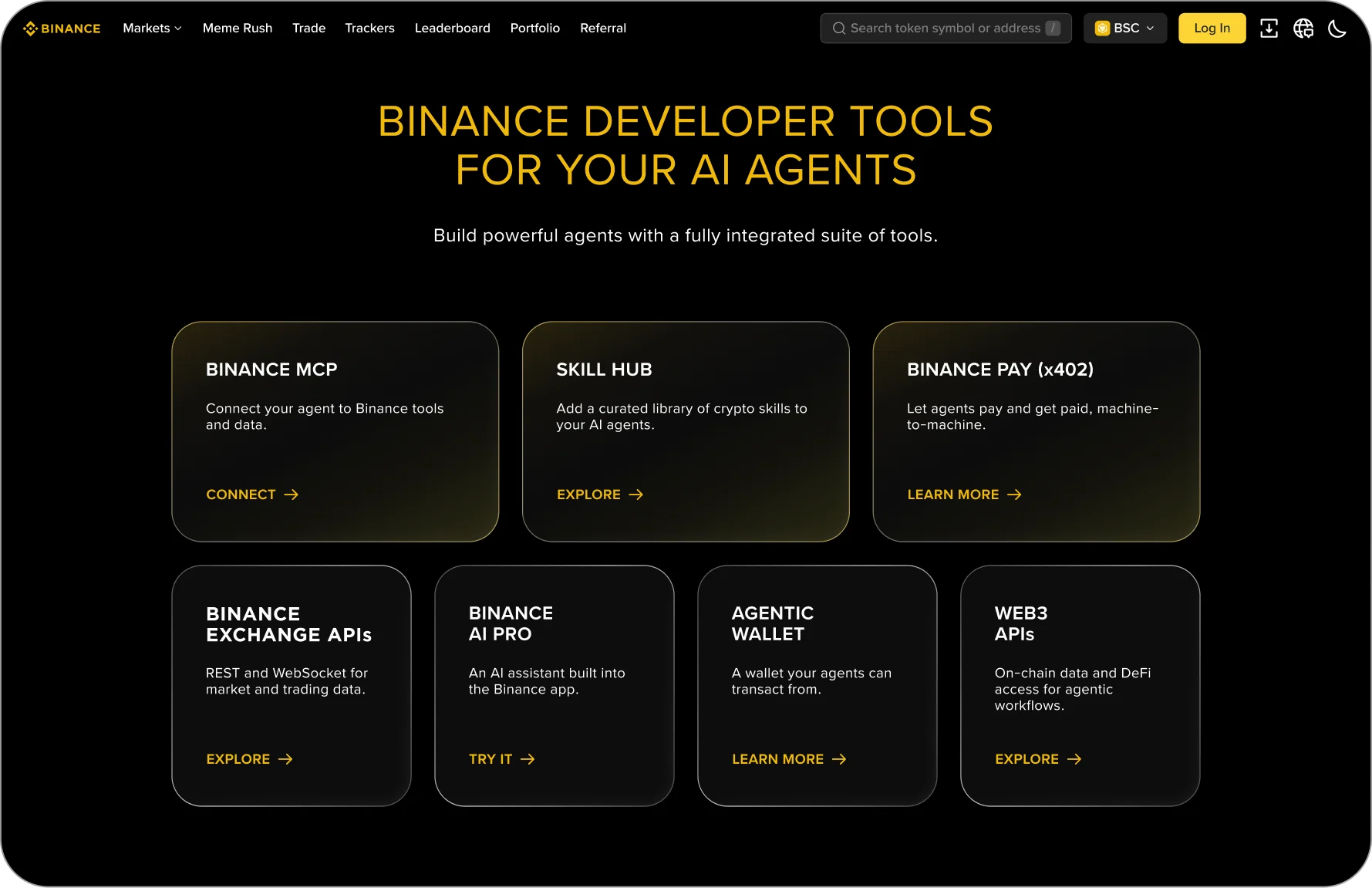
Agent OS brings several existing Binance developer products together under a common framework.
Its components include Binance APIs, the Binance Wallet Agentic Hub, Binance x402 for programmable payments, and the Binance Skill Hub.
The platform also introduces support for the Model Context Protocol, an open standard that allows compatible AI applications to connect with external tools and data sources.
Integrating MCP gives developers and partners a standardized method of connecting AI agents to Binance services, reducing the need to build a separate integration for every product or use case.
Initial MCP Integration Supports Trading and Account Access
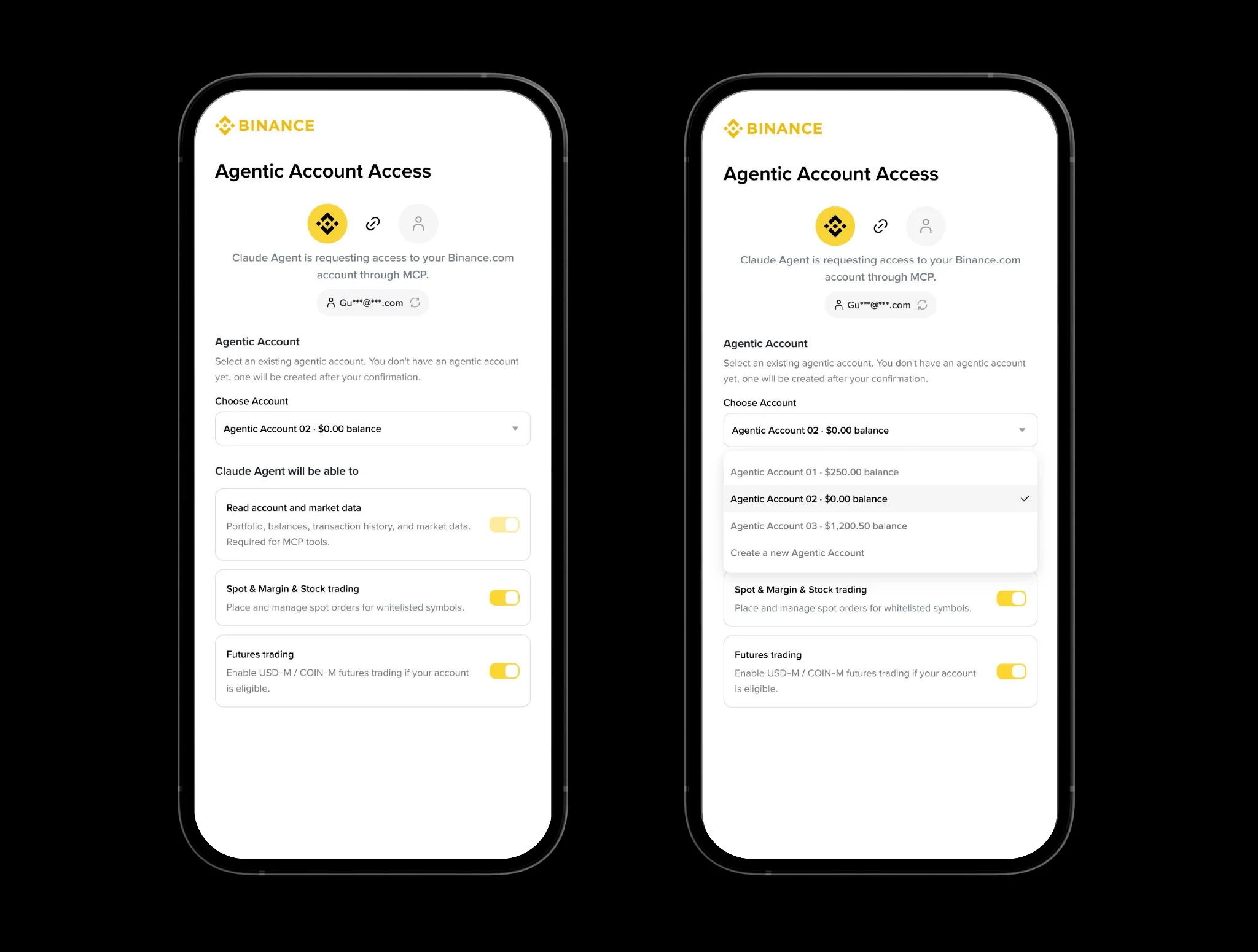
Binance’s initial MCP implementation allows compatible AI applications to access market information, retrieve read-only account data, and place trades.
Agents can view the balances, portfolio holdings, and transaction history of a designated subaccount. They can also inspect balance and portfolio information associated with the user’s main account.
However, agents cannot access non-trading personal information, including email addresses and Know Your Customer data.
The separation is intended to give agents the financial information needed to perform assigned tasks without exposing unrelated personal account details.
Users can assign each AI agent to a dedicated subaccount, separating its funds and trading activity from the rest of their Binance holdings.
They can determine which information and trading functions an agent may access, configure operational limits, and revoke authorization at any time.
The subaccount structure could help developers test AI strategies while limiting their access to a defined pool of capital.
It may also allow users to separate multiple agents or strategies, making their individual performance and transaction histories easier to monitor.
Binance Monitors Trades But Not Agent Reasoning
Binance can monitor trading activity initiated through Agent OS, including resulting orders, and apply its usual platform controls.
However, the exchange said it cannot see the agent’s broader workflow, reasoning, external information sources, or interpretation of data.
Those processes remain within the AI application selected by the user.
This creates a division of responsibility: Binance controls access to its infrastructure and monitors the resulting financial activity, while the external AI application manages how an agent analyzes information and reaches decisions.
Users therefore remain responsible for selecting the agent’s permissions, evaluating its behavior, and limiting the funds it can control.
Agent OS positions Binance as an infrastructure provider for developers building AI-driven trading, payment, and portfolio applications.
By combining standardized access, programmable payments, wallets, market data, and trading functionality, the exchange aims to make it easier to develop agents capable of completing financial tasks across multiple markets.
The platform could support applications ranging from market monitoring and portfolio analysis to quantitative strategies and automated trade execution.