



Tokenization Is the First Step, Proof Is the Next
Real-world asset tokenization is one of the few success stories coming out of this bear market, moving from crypto experiment to a meaningful segment of on-chain finance. As of August 2026, roughly $38.2 billion sits in distributed tokenized assets.
Much of that growth has centred on assets that are relatively straightforward to represent digitally: Treasuries, credit, commodities and funds. But tokenization is expanding into infrastructure and other physical assets, and a difficult question is emerging.
Not all assets that are tokenized have as straightforward of a path to become RWAs. New asset classes are opening, so new questions emerge of how to truly represent a physical asset accurately and honestly onchain.
One of these new assets to become tokenized are shipping vessels. A vessel does not sit in a vault. It keeps moving between jurisdictions, entering ports, anchoring, changing operational status and generating events that can affect its value and risk profile. A blockchain can prove what happened to a token, but it cannot, by itself, prove what happened to the ship.
The physical to digital gap
More than 80% of international trade in goods by volume is carried by sea, according to UN Trade and Development, so the business case to tokenize shipping vessels brings real utility in a critical industry.
If vessels increasingly become the underlying assets for tokenized financing, investment or insurance products, maintaining a credible link between the digital side of the blockchain and the physical asset is highly important.
Consider a tokenized interest in a vessel: the token accurately represents ownership or an economic claim, but market participants still need to establish whether the vessel arrived at a particular port, remained anchored for an unusual period, changed its reported identity or was present where existing systems suggested it was. Those facts exist outside the blockchain.
Maritime markets already have extensive data infrastructure, namely the Automatic Identification System (AIS). But AIS was designed primarily to transmit information such as a ship's identity and position, not to serve as an infallible record of physical reality. In fact, a current U.S. Maritime Administration advisory describes AIS as an open, unencrypted radio system and warns that signals can be spoofed, producing incorrect or missing data. It explicitly advises that AIS should not be solely relied upon for navigational decisions.
The International Maritime Organization also lists falsified AIS broadcasts as a tactic used for fraudulent ship registration, including manipulation of identifying information or transmission of another vessel's AIS identity. For RWAs and maritime shipping at large, the issue turns from a data problem into an evidence problem, and thus a reliability issue.
RWAs need evidence
One model is to establish an evidence layer between a physical asset and the financial instrument representing it. Instead of trusting a single source, an event could be corroborated using several independent signals: vessel and port records, terrestrial receivers, satellite-derived information and geolocated visual observations.
Sea Verity, an initiative being developed by Ethra Ship, a project tokenizing maritime ships, is an early attempt at this type of architecture. Its model combines different maritime data sources and observations before producing confidence-scored events with a traceable source trail.
The broader idea is more significant than any individual platform:
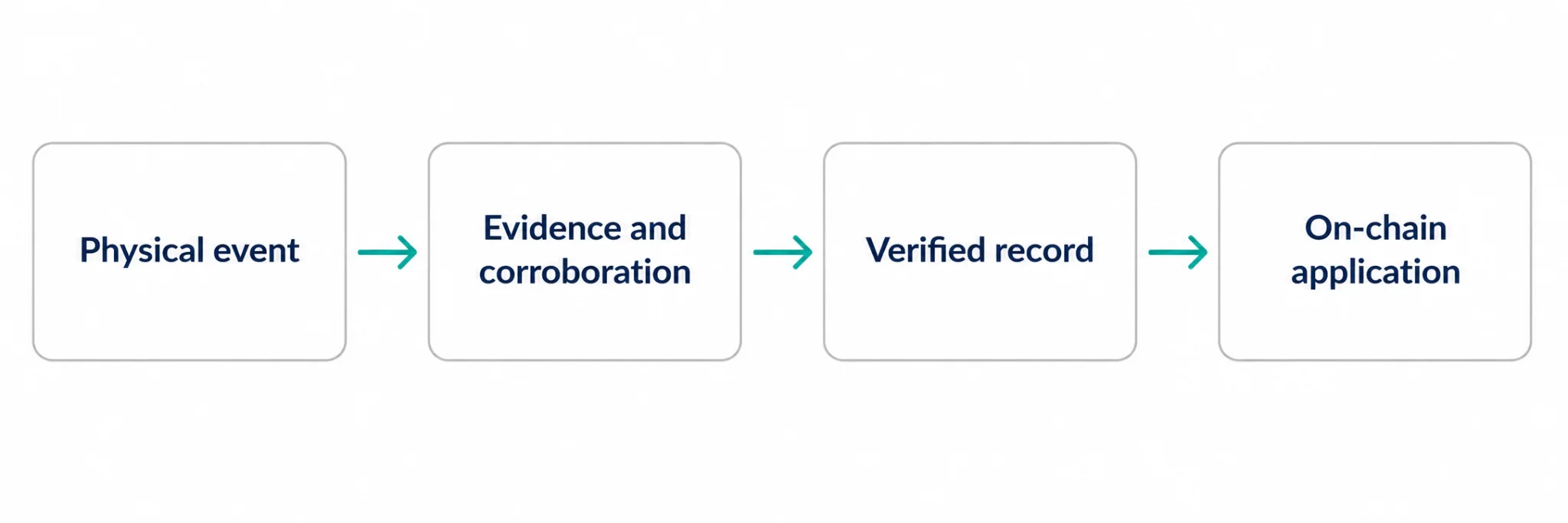
That is a marked change from the traditional blockchain oracle model.
The challenge with real-world assets is that reality is not always binary. Data can conflict, signals can disappear, sources vary in quality. A useful evidence system therefore needs to preserve provenance and uncertainty rather than turning every external observation into an unquestionable on-chain fact.
For a maritime RWA, knowing that a system has classified a vessel as being at a particular location is useful. Knowing which signals produced that conclusion, how independently they corroborate one another and how confident the system is could be considerably more valuable.
Tokenization makes verification more important, not less
Much of RWA tokenization today is concerned with representing ownership and improving financial rails around existing assets. That could change as tokenized products become more sophisticated.
Maritime lending could reference verified vessel activity. Insurance products could depend on evidence surrounding operational events. Trade-finance structures could use verified arrival or departure information. Investors in fractionalized maritime assets might want independent confirmation of unusual inactivity or changes in vessel behaviour.
At that point, trustworthy off-chain information becomes a part of the financial infrastructure.
Sea Verity's initial proposed deployment in Fujairah and the Strait of Hormuz reflects the practical challenge.Instead of trying to verify every maritime event, the project plans to test evidence quality, verification latency and the cost of producing useful events within strategically important maritime corridors.
That is also a useful way to think about the next stage of RWAs. Tokenization can make ownership programmable, but the credibility of a tokenized physical asset ultimately depends on the systems connecting that token back to reality.
For static assets, that connection may only need to be checked periodically. For ships, it moves every day. Tokenization establishes the claim, but the infrastructure challenge is proving that the real-world asset continues to support it.
***
DISCLAIMER
The views, the opinions and the positions expressed in this article are those of the author alone and do not necessarily represent those of https://www.cryptowisser.com/ or any company or individual affiliated with https://www.cryptowisser.com/. We do not guarantee the accuracy, completeness or validity of any statements made within this article. We accept no liability for any errors, omissions or representations. The copyright of this content belongs to the author. Any liability with regards to infringement of intellectual property rights also remains with them.
Comments
Log in to post a comment
No comments yet
Be the first to share your thoughts!