


Poker Rake and Bitcoin Fees: Who Charges for What?
Funding an online poker account with Bitcoin can bring several charges into view: a wallet’s transaction fee, a cash table’s rake, and a tournament’s entry fee. They relate to the same activity, but pay for different services. Understanding them starts with identifying who receives each charge, what triggers it, and whether its calculation uses a poker pot, a tournament entry, or the amount of data in a Bitcoin transaction.
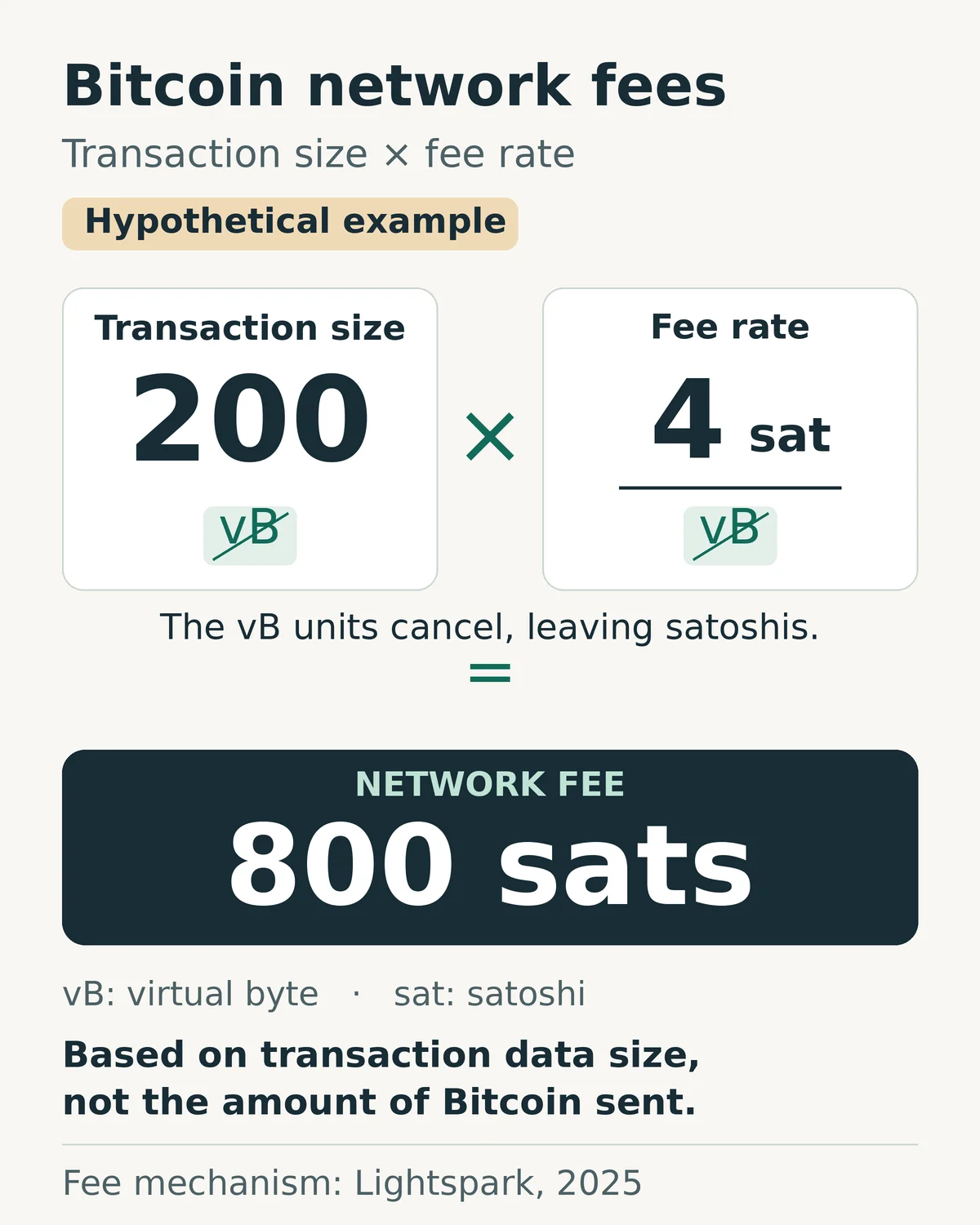
A Bitcoin network fee goes to the miner that includes the transaction in a block. Lightspark’s explanation of how Bitcoin fees are calculated describes a calculation based on transaction size and a fee rate. It is not a percentage of the value of Bitcoin sent.
Cash-game rake follows the pot
In cash games that charge rake per pot, the room deducts its fee under the published rules. The pot contains the players’ bets for that hand. A rake schedule explains how the deduction is calculated and where it stops. Its relevant conditions can include the game’s betting structure, the stakes, and the number of players, so one row cannot automatically describe every table.
The poker room receives rake for running the game; the miner receives a network fee for including a Bitcoin transaction. In crypto poker, funding an account with cryptocurrency does not turn a deduction from a poker pot into a blockchain charge. A wallet’s fee quote therefore cannot tell you what the table charges, even when the wallet transfer funds that poker account.
Read the rate and the maximum together. A schedule might express rake as an amount removed for each specified increment in the pot, with a separate maximum. The maximum is a ceiling for that pot under the applicable rules.
Once the calculated rake reaches that ceiling, further growth in the pot does not increase the deduction under the same capped rule. Two schedules with the same maximum need not produce identical charges on smaller pots if their rates differ. Equally, an identical rate does not make different caps interchangeable.
The cap applies separately to each eligible pot. It does not cap the room’s deductions across a whole session; calculating the room’s total deductions for a session requires adding the rake collected from those pots. Keep the currency attached to the figures, too. A cap stated in US dollars remains a dollar amount when Bitcoin is the funding method.
Tournament entry fees follow registration
A tournament separates the contribution to its prize pool from the organizer’s entry fee. Both may form part of the amount paid to enter, but they serve different purposes. Calling the entire entry payment a fee would obscure that distinction: the organizer’s charge is only one component.
The trigger also changes. An entry fee belongs to the registration, rather than being deducted from each tournament pot as cash-game rake. Playing another hand does not create another registration fee. The stated entry fee therefore cannot be compared directly with a per-pot percentage without accounting for what each number measures.
When reading an event listing, identify whether a displayed amount represents the contribution, the organizer’s fee, or the combined total. A fee described as a percentage needs a stated calculation basis too. A percentage of the contribution uses a different base from a percentage of the total entry payment.
Three charges, three calculation bases
|
Charge |
Recipient |
Trigger |
Calculation basis |
|
Cash-game rake |
Poker room |
A pot subject to rake |
Published pot-based rule and applicable cap |
|
Tournament entry fee |
Tournament organizer |
Registration |
Stated fee for that entry |
|
Bitcoin network fee |
Miner |
Inclusion of an on-chain transaction |
Transaction size multiplied by fee rate |
A rate and a final charge are different figures. Calculating pot-based rake requires the pot size, scheduled rate, and cap. Calculating a Bitcoin fee requires transaction size and fee rate. An organizer’s fee stated as an amount already describes the charge for that entry.
Bitcoin fee estimates depend on network conditions
Bitcoin fee rates are commonly expressed in satoshis per virtual byte, written sat/vB. A satoshi, abbreviated to sat, is one hundred-millionth of a bitcoin. A virtual byte is a unit used to measure transaction size for fee purposes. Consider a hypothetical transaction measuring 200 vB with a selected fee rate of 4 sat/vB. Multiplying 200 vB by 4 sat/vB gives a network fee of 800 sats.
A fee estimator uses information about network activity to suggest a rate for a transaction. Block Engineering’s account of Bitcoin fee estimation explains that historical observations can lag behind changing conditions and that estimators can have different views of pending transactions. The suggested rate reflects those observations and assumptions, so estimates can change when network conditions change.
A service’s separately listed withdrawal charge also needs its own explanation; it cannot be assumed to equal the network fee. For poker charges, the relevant evidence is the applicable rake schedule or tournament entry breakdown. For a network charge, it is the transaction’s size and fee rate. A label such as “withdrawal fee” alone does not establish who receives the money or how the amount was calculated.
Comments
Log in to post a comment
No comments yet
Be the first to share your thoughts!
