



Quickex Review 2026: How It Works, Fees and Limits
Independent Quickex review 2026: how the exchange works, real fees (0.5–1%), limits, AML policy, speed and pros & cons. Read before your first swap.
Quickex is an accountless instant crypto exchange that launched in 2018. Standard swaps require no registration or mandatory KYC. Fees are 0.5% floating or 1% fixed plus network costs. Limits are dynamic. AML screening can still pause high-risk deposits. The service works well for many pairs, including USDT TRC20 to XMR, but has clear limitations on compliance freezes, liquidity for niche assets and jurisdictional restrictions.
Disclaimer
This is an independent review for informational purposes only. It is not financial, legal or investment advice.
Cryptocurrency involves risk. Policies, rates and limits change. Always verify the live interface and official documentation before sending funds.
Last reviewed: 25 August 2026.
Table of Contents
- What is Quickex and how does it work?
- Step-by-step swap process
- Does Quickex require KYC or registration?
- Fees, fixed vs floating rates, Cashback and VIP benefits
- Limits: minimums and maximums
- Supported assets and notable gaps
- How fast are Quickex swaps?
- What is Quickex Private Swap?
- What happens if a transaction is flagged by AML
- Safety and user feedback
- Where Quickex performs well
- Where Quickex falls short
- Who Quickex is not for
- Practical example: USDT TRC20 to XMR
- Conclusion
- FAQ
What Is Quickex and How Does It Work?
Quickex is an instant cryptocurrency exchange that launched in 2018.
It operates on a wallet-to-wallet model: users swap one cryptocurrency for another without creating an account for standard trades.
The service does not maintain long-term user balances.
Funds move from the user’s wallet to a temporary deposit address and then to the destination wallet, although during the short processing window the assets are controlled by the service or its liquidity partners.
Quickex aggregates liquidity from multiple sources and supports a wide range of pairs.
As of 25 August 2026 the platform lists 100+ cryptocurrencies and a very large number of exchange combinations, including major assets, stablecoins and privacy coins such as Monero.
Step-by-Step Swap Process
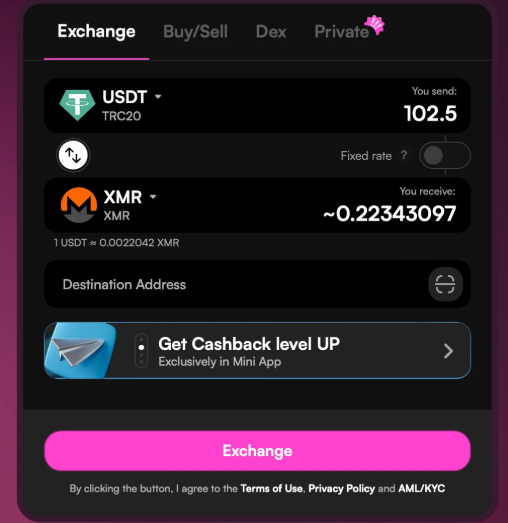
- Select the pair, for example BTC/XMR or USDT TRC20/XMR, and enter the amount.
- Paste the receiving wallet address and choose floating or fixed rate.
- Review the estimated receive amount, applicable rate type and network information. For a floating-rate order, the final output may differ from the initial estimate.
- Create the order and send the exact amount from your wallet to the unique deposit address shown.
- Track the order status on the same page. Once the deposit is confirmed and processed, the exchanged assets are sent to your destination address.
Does Quickex Require KYC or Registration?
No for standard swaps. Only a receiving wallet address is required.
No email, phone number or identity documents are requested for ordinary transaction sizes. Registration is optional.
Users who create an account gain access to the VIP programme, cashback and the affiliate programme.
The platform may still run automated AML screening on incoming funds according to its published policy.
High-risk deposits can be paused and may require verification.
Fees, Fixed vs Floating Rates, Cashback, and VIP Benefits
According to the official Terms of Use:
- Floating rate: 0.5% + network commission. No hidden fees. The rate is determined when the funds are credited.
- Fixed rate: 1% + network commission. No hidden fees. The rate is frozen for approximately 12–15 minutes. If the market rate changes by more than 1.3% before the transaction is detected on the blockchain, the user is offered a refund or the option to proceed at the market rate.
The interface displays an expected receive amount before funds are sent. For floating-rate orders, the final amount depends on the market rate applied during execution.
Cashback Programme
Users with a free Quickex account can participate in the cashback programme. Cashback is calculated from the service fee and credited in USDT, while the applicable percentage depends on the user’s 30-day trading volume and VIP level.
According to the official Quickex Cashback page, VIP1 starts at $50,000 in monthly trading volume and provides:
- 15% cashback on floating-rate fees;
- 25% cashback on fixed-rate fees.
The displayed cashback rates increase at higher levels, reaching 45% at VIP4 in the current calculator. Users should check the live programme page because thresholds, percentages and withdrawal conditions may change.
VIP Fee Benefits
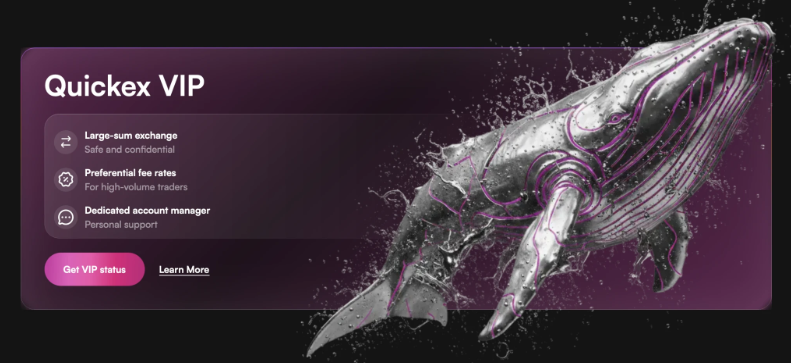
Quickex also advertises separate VIP conditions for high-volume users and business partners. According to the official Quickex VIP page, these benefits may include commission reductions of up to 50%, priority processing and individual exchange conditions.
Cashback and commission reductions are separate benefits: cashback returns a portion of the fee after an eligible exchange, while a commission reduction lowers the fee applied to the transaction itself. The percentages should not be treated as interchangeable.
Limits: Minimums and Maximums
Minimum order size is dynamic and tied to network and miner costs.
On interface checks performed on 25 August 2026:
- USDT TRC20 → XMR showed a low double-digit USDT. Minimum order amounts are dynamic and vary by pair, network costs and provider conditions. The current minimum is displayed in the exchange interface.
- Other major pairs similarly displayed dynamic thresholds in the low double-digit USD equivalent.
There is no fixed published maximum for standard no-account swaps.
Practical upper limits depend on available liquidity and the outcome of risk screening. Practical order capacity depends on the selected pair, network and available liquidity. AML review is governed by the current risk-screening policy.
Supported Assets and Notable Gaps
As of 25 August 2026 Quickex supports 100+ cryptocurrencies and a very large number of pair combinations.
This includes major assets, stablecoins, USDT on several networks, and privacy coins such as Monero. Direct routes including BTC–XMR, ETH–XMR and USDT–XMR remain available.
Limitations exist. Some pairs may be temporarily unavailable or quoted differently as provider availability and market conditions change.
Transactions associated with specified high-risk labels, sanctioned platforms or prohibited sources may be blocked under the AML Policy.
Fiat services, where offered, operate under different rules and often involve third-party providers with their own requirements.
How Fast Are Quickex Swaps?
Most swaps finish between 5 and 30 minutes.
Platform-displayed statistics have shown short averages across recent orders, while longer historical averages across all pairs fall in the 14–16 minute range.
Actual time is determined by the confirmation requirements of the sending and receiving blockchains.
The table below summarises typical completion windows based on Quickex interface estimates and published platform statistics checked on 25 August 2026.
Independent timed swaps were not performed for this review.
|
Pair |
Typical Completion Time |
Notes |
|
BTC to USDT |
1–10 min |
TRC-20 side usually fast |
|
BTC to XMR |
10–30 min |
Depends on BTC confirmations |
|
XMR to USDT |
10–20 min |
TRC-20 preferred |
|
XMR to BTC |
15–40 min |
Depends on BTC confirmations |
|
ETH to XMR |
10–25 min |
Depends on ETH network load |
|
USDT to XMR |
10–20 min |
TRC-20 preferred |
|
SOL to USDT |
under 10 min |
TRC-20 preferred |
|
USDT to BTC |
10–30 min |
Depends on BTC side |
Network congestion remains the most common cause of longer times. Live progress is shown on the order page.
What Is Quickex Private Swap?
Private Swap is an optional routing method that sends the trade through two separate liquidity venues and a temporary intermediate asset, commonly USDT on TRON.
As a result, the original sending address and the final receiving address are not directly linked on the public blockchain.
It is useful for users who want to reduce the visible on-chain connection between two personal wallets.
It does not provide absolute anonymity and remains subject to the same AML screening as standard swaps.
Details are available on the official Private Swap page.
What Happens If a Transaction Is Flagged by AML
According to the official AML Policy:
- Assets that fail AML verification cannot be exchanged.
- The service may request identity documents and proof of the origin of funds.
- Blocked assets may be refunded only after successful KYC, subject to the conditions in the AML Policy. The policy states a 5% refund commission and also reserves the right to apply an additional fee of up to 5% to transactions with specified high-risk characteristics.
- Refunds are normally returned only to the original sending address.
- If the requested information is not provided within 30 calendar days, the return of assets may become impossible.
- In cases involving law-enforcement requests or liquidity-provider decisions, further restrictions can apply.
The service encourages users sending larger amounts or coins from P2P or mixed sources to contact support for a free pre-check before creating an order.
Safety and User Feedback
Quickex launched in 2018 and does not maintain long-term user balances.
Independent feedback on Trustpilot, checked 25 August 2026, shows a mixed but generally positive pattern for standard swaps, with many users highlighting speed and rate accuracy.
A recurring theme in negative reviews is delays or freezes linked to AML screening, with varying experiences regarding resolution speed and communication.
The support team frequently replies publicly to disputed cases.
As with any instant swap service, users remain exposed to address errors, network congestion and compliance holds.
Where Quickex Performs Well
- No account required for standard crypto-to-crypto swaps.
- Transparent display of the exact receive amount before sending funds.
- Support for popular privacy routes, including Monero pairs.
- Clear published rules for fixed and floating rates.
- Optional VIP cashback for higher-volume users.
- Private Swap routing option.
- Relatively long operational history since 2018.
Where Quickex Falls Short
- AML screening can freeze deposits even when no account was created.
- Refund conditions after a flag can include fees and a 30-day deadline.
- Minimums are dynamic and can vary by pair.
- Liquidity and spreads for less popular assets are not always competitive.
- Jurisdictional restrictions apply.
- User experiences with compliance reviews are not uniformly positive.
Who Quickex Is Not For
Quickex is less suitable for users who need an absolute guarantee that no compliance review will ever occur, who require very large single transactions with zero chance of delay, who are located in restricted jurisdictions, or who are uncomfortable providing documents if a deposit is flagged.
Users seeking fully decentralised, non-custodial atomic swaps or pure on-chain solutions will also find the model different from their requirements.
Practical Example: USDT TRC20 to XMR
One of the frequently used routes is USDT TRC20 to XMR.
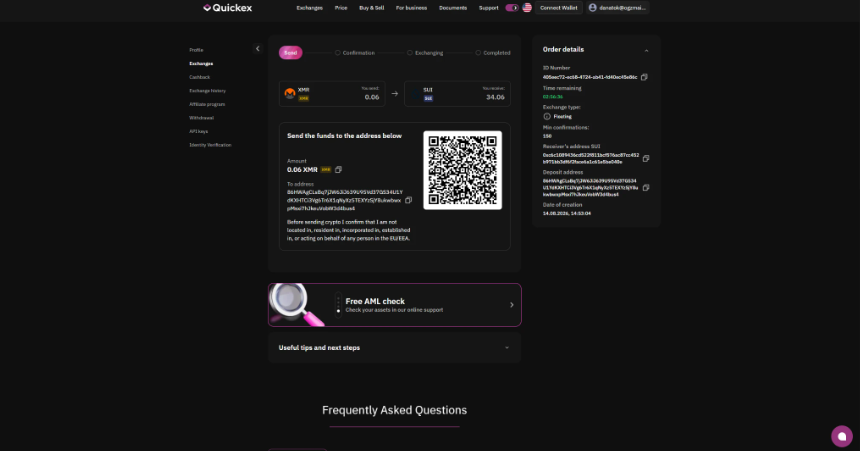
The process follows the standard accountless flow: select the pair, enter a Monero receiving address, choose rate type, send USDT TRC20 to the generated deposit address, and wait for processing. After the USDT confirms on TRON, the service sends XMR.
Most Monero wallets unlock newly received funds after 10 confirmations, approximately 20 minutes under normal conditions.
Conclusion
Quickex is an accountless instant exchange that supports standard crypto-to-crypto swaps, including routes such as USDT TRC20 to XMR.
Its published service fees are 0.5% plus the applicable network fee for floating-rate exchanges and 1% plus the applicable network fee for fixed-rate exchanges. Minimum amounts and quoted outputs are dynamic and should be checked in the live exchange interface.
Registered users may receive cashback based on their 30-day trading volume and VIP level. Separately, Quickex advertises commission reductions and individual conditions for high-volume users and business partners. Cashback and fee reductions are distinct benefits.
Private Swap provides an additional routing option designed to reduce the direct on-chain connection between sending and receiving addresses. It does not guarantee anonymity and remains subject to Quickex’s AML/KYC Policy.
Transactions identified as higher risk may be paused and require identity or source-of-funds verification. The AML Policy states that blocked assets may be refunded only after successful KYC and subject to applicable conditions and fees. If the requested information is not provided within 30 calendar days, a refund may no longer be possible.
Users should also consider dynamic pair availability, temporary control of funds during execution and jurisdictional restrictions. Quickex currently states that its services are unavailable to persons located in, resident in, incorporated in, established in or acting from the EU/EEA.
Users who understand these conditions should verify the live quote, review the current Terms and AML Policy, and confirm that the service is available in their jurisdiction before creating an order.
FAQ
Is Quickex non-custodial?
Quickex does not maintain long-term user balances and operates on a wallet-to-wallet model.
Assets move from the user’s wallet to a temporary deposit address and then to the destination wallet.
During the short processing window the funds are controlled by the service or its liquidity partners.
Does Quickex require registration or KYC?
No — standard Quickex crypto-to-crypto swaps do not require account registration or mandatory KYC.
Only a receiving address is needed. An optional account unlocks VIP cashback.
High-risk deposits can still trigger verification under the published AML policy.
What fees does Quickex charge?
Floating-rate swaps are charged 0.5% + network fees; fixed-rate swaps are charged 1% + network fees according to the official Terms of Use.
The fixed rate is locked for approximately 12–15 minutes.
If the market moves more than 1.3% before detection, a refund or market-rate option is offered.
How long do Quickex swaps take?
Most swaps finish between 5 and 30 minutes, depending on the blockchains involved.
TRC-20 routes are usually among the fastest; pairs involving Bitcoin or Monero take longer because of confirmation requirements.
The figures above are based on platform estimates checked on 25 August 2026.
What is Quickex Private Swap?
It is a routing method that uses two liquidity venues and an intermediate asset so the original sending address and the final receiving address are not directly linked on-chain.
It remains subject to the same AML screening as standard swaps.
Can I swap USDT TRC20 to XMR on Quickex without registration?
Yes — the pair is supported for standard accountless orders.
Users can start here: USDT TRC20 to XMR
Those seeking absolute certainty of zero compliance review should weigh the limitations carefully. Information drawn from Quickex’s official Terms of Use, AML Policy, VIP page, public interface data and independent user feedback as of 25 August 2026. Conditions change — always re-check before transacting.
***
DISCLAIMER
The views, the opinions and the positions expressed in this article are those of the author alone and do not necessarily represent those of https://www.cryptowisser.com/ or any company or individual affiliated with https://www.cryptowisser.com/. We do not guarantee the accuracy, completeness or validity of any statements made within this article. We accept no liability for any errors, omissions or representations. The copyright of this content belongs to the author. Any liability with regards to infringement of intellectual property rights also remains with them.
Comments
Log in to post a comment
No comments yet
Be the first to share your thoughts!