 Hassan Maishera

2025 was one of the most eventful years in the history of the cryptocurrency market. The arrival of institutions, thanks to the approval of spot cryptocurrency exchange-traded funds (ETFs), shows that the market was growing.
The derivatives market remains one of the leading areas in the crypto space. In this report, BitMEX looked at some of the highlights of the crypto derivatives market in 2025 and the current state of the market.
The Auto Deleveraging (ADL) Crisis in October Defined the Market in 2025
In its report titled ‘State of Crypto Perpetual Swaps 2025’, BitMEX pointed out that the most defining event of 2025 was a microstructure failure among most crypto exchanges.
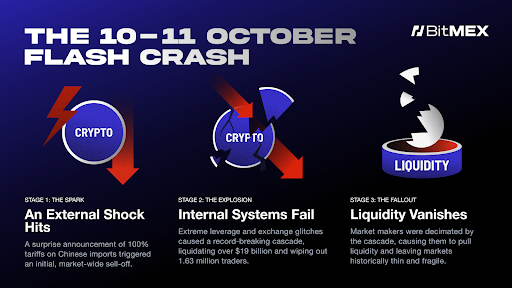
The 10-11 October crash was caused by the ADL feedback loop that harmed the market’s liquidity providers.
The 10-11 October crash triggered a record $20 billion liquidation cascade—the largest in history and far more destructive to professional market makers than any event in previous cycles.
BitMEX added that thanks to the event, "safe" delta-neutral strategies were cannibalised by the very engines meant to protect them, leaving the market with the thinnest order books since 2022.
-
The Delta-Neutral Slaughter: Historically, retail traders are the victims of liquidation cascades. On 10 Oct, it was the Market Makers (MMs). MMs running standard Delta-Neutral strategies (Long Spot / Short Perp) found their profitable short legs aggressively auto-deleveraged by exchange engines desperate to cover bankrupt long positions.
-
Forced Exposure: When ADL mechanisms forcibly closed MM short hedges, these firms were left holding naked spot bags in a free-falling market.
-
The Aftermath: This breach of the "neutrality" promise caused MMs to pull liquidity globally in Q4, resulting in the thinnest order books seen since 2022.
BitMEX added that they warned about the fragility of crowded structural trades early in the year in their Q3 Derivatives report. The crypto exchange also provided a thorough review of the systemic risks in this cycle, including mitigation strategies in their article, BitMEX Alpha: Understanding Systemic Risk Before Your Next Trade.
The Funding Rate Arbitrage Saturation
In the report, the second major event BitMEX highlighted was the funding rate arbitrage saturation. According to BitMEX, while 2024 was the year Ethena (USDe) successfully productised the funding rate arbitrage trade, 2025 was the year the trade fell victim to its own success. The Long Spot/Short Perp strategy didn’t blow up; it simply ground to a halt.
-
Copying the Ethena Mechanism: while it began as Ethena’s novel mechanism, major centralized exchanges quickly commoditised the idea. The launch of exchange-native delta-neutral margin assets—most notably Binance’s BFUSD and similar sUSDe clones—flooded the market with structural short inventory. Every dollar minted into these products automatically sold a perpetual swap to hedge.
-
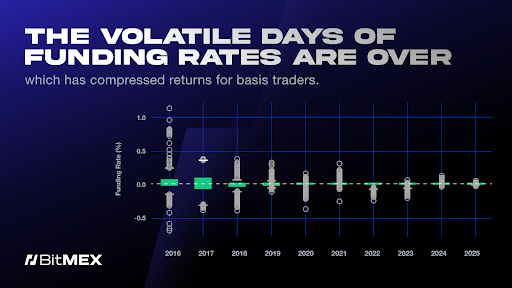
Shorts Overpowered the Longs: What follows is that the supply of shorts overwhelmingly outpaced organic long demand. The result was a collapse in funding rates.
Below Baseline: These conditions resulted in history happening. For the first time in a bull cycle, funding rates consistently trended below the industry standard baseline of 0.01% per 8 hours (approx. 11% APY).
The 4% Reality: By mid-2025, the "risk-free" crypto yield had compressed to sub-4%, often underperforming US Treasury Bills.
-
The Takeaway: Ultimately, this resulted in the near absence of double-digit passive yields on stablecoins. The arbitrage has been closed by massive institutional participation and exchange-level integration.
BitMEX added that it anticipated this mean reversion. In its study, 9 Years of Funding Rate Analysis, the team highlighted that while funding rates spike, they inevitably trend toward efficiency as markets mature. With this knowledge, BitMEX pivoted its users toward more sophisticated yield harvesting strategies, such as the opportunities detailed in The BitMEX-Pendle sENA Arbitrage, proving that in 2025, alpha requires activity, not just passivity.
The Ugliness of B-Book Exchanges
The report added that 2025 exposed the ugly underbelly of the B-Book "Casino" exchange model.
-
The "Profit Confiscation" Scandal: 2025 was a major breakdown of trust in the crypto space as certain exchanges were caught invoking "abnormal trading behaviour" clauses to seize funds from profitable traders. This showed that aggressive B-Book operations were taking the other side of user trades and refusing to pay out when they lost.
-
The Momentum ($MMT) Squeeze: Last year also exposed the weaponisation of low-float listings, thanks to the MMT incident. This is where a coordinated entity cornered spot supply to squeeze perp Open Interest (OI). This proved that pre-market and low-cap perps had become venues for insider wash trading.
With B-Book opacity dominating the market, BitMEX remains committed fair, transparent derivatives trading engine. This exchange utilizes a P2P model and doesn’t confiscate profit.
BitMEX exposed these dynamics in their article, BitMEX Alpha: Understanding Systemic Risk Before Your Next Trade, emphasising that where you trade is as important as what you trade.
The Rise of Perp DEXs
Perpetual decentralized exchanges like Hyperliquid recorded massive trading volumes in 2025. However, last year also proved that decentralisation is not a panacea for market manipulation.
-
The "Pre-Token Generation Event (TGE) Oracle" Attack (Plasma Incident): 2025 saw the manipulation of illiquid pre-TGE tokens with no real oracle to trigger liquidations on on-chain perp positions. The Plasma ($XPL) incident demonstrated that on-chain transparency cannot protect users as much as credible CEXs can. However, unlike decentralised protocols that treat transparency as a virtue even when it becomes a vulnerability, credible exchanges can prevent targeted liquidation hunting and battle-tested risk engines. Most importantly, CEXs offer accountability: when a system error occurs, they are liable to make users whole, whereas decentralised protocols often absolve themselves of responsibility under the guise of ‘the code is the law’.
-
Platform Risk: In December 2025, a user identified a mispricing in Paradex’s options market where implied volatility was quoted significantly below market value. The user executed trades to capitalise on this pricing error—a standard practice in efficient markets known as arbitrage. However, instead of honouring the trade, Paradex froze the user’s account and voided ~$219,000 in profits, labeling the user an "attacker" for exploiting their bad data.
BitMEX operates differently by actively covering the opportunities in the Perp DEX space, such as in their article, Hyperliquid Ecosystem Airdrop Opportunities. However, BitMEX would advise caution regarding aping in size for new perp DEXs and to read their documentation carefully before placing any trades.
Equity Perps & Funding Rate Trading: The New Frontiers of the Market
According to the report, the market evolved into two distinct camps: High Frequency Trading (HFT) predation and exotic speculation, thanks to the failure of the traditional strategies.
-
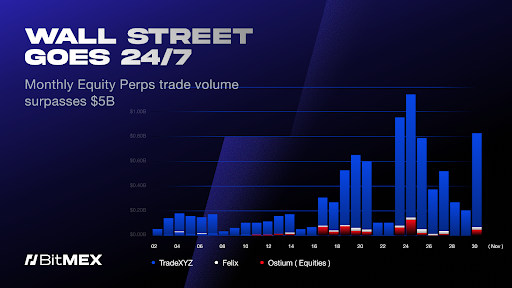
The 24/7 Wall Street Meta – Equity Perps: Crypto derivatives found true product-market fit as the backend for trading TradFi assets. The demand to leverage trade US stocks like Nvidia and Tesla outside the 9:30 AM – 4:00 PM window exploded, and crypto exchanges like BitMEX are becoming the primary venue for speculation, especially ahead of earnings reports.
-
Funding Rate Trading: In response to the volatility of funding rates, the market moved to trade the rate itself. Traders stopped passively farming and began speculating on funding volatility (hedging spikes vs. betting on spirals).
BitMEX was at the forefront of the crossover between crypto and traditional equities markets. For starters, the exchange launched Equity Perps on BitMEX, allowing traders to use crypto as collateral to gain exposure to top US stocks and indices – 24/7/365.
BitMEX also made a thorough analysis of TradFi and crypto convergence in its article, DAT Stocks vs Crypto and further extended it to provide specific strategies in BitMEX Alpha: Equity Perp Funding Arbitrage on Hyperliquid.
Looking Ahead to a Fairer and More Grounded Future
Last year, the crypto perpetual swaps market faced a reckoning, marked by the ADL crisis and the end of easy funding arbitrage yield. These events made transparency and fair dealing essential.
BitMEX continues to lead the market thanks to its commitment to fairness and transparency. The market has matured, and only battle-tested exchanges focused on fairness, security, and reliable infrastructure will thrive.