


AI and Blockchain: How Market Leaders Monetize Synergy
AI in 2026 has reached a juncture where the cost of compute is now far more than the cost of employees.
Companies are concerned about what would happen if, after spending those billions on cloud GPUs, data centers, and high-bandwidth memory hosting capacity, they’d still need to hire human heads to oversee things.
Investors tracking the biggest crypto companies are now simply asking the question: which firm can actually turn demand into revenue without bragging about their efficiency?
Meaning scarce resource usage = better business.
AWS, Microsoft Azure, and Google Cloud right now are the best builders of enterprise AI, given their security, compliance, networking, and managed tooling capabilities. But that’s not quite the buy for small-scale teams and mid-sized corps due to GPU availability uncertainties and rising bills due to AI usage costs.
Blockchain can only be of help for hardware coordination, payment settlements, data tracking, and maybe revenue monitoring/sharing (very long-term). Still using it for every prompt, agent, or product just means added latency and costs.
Solution #1: The DePIN revenue model
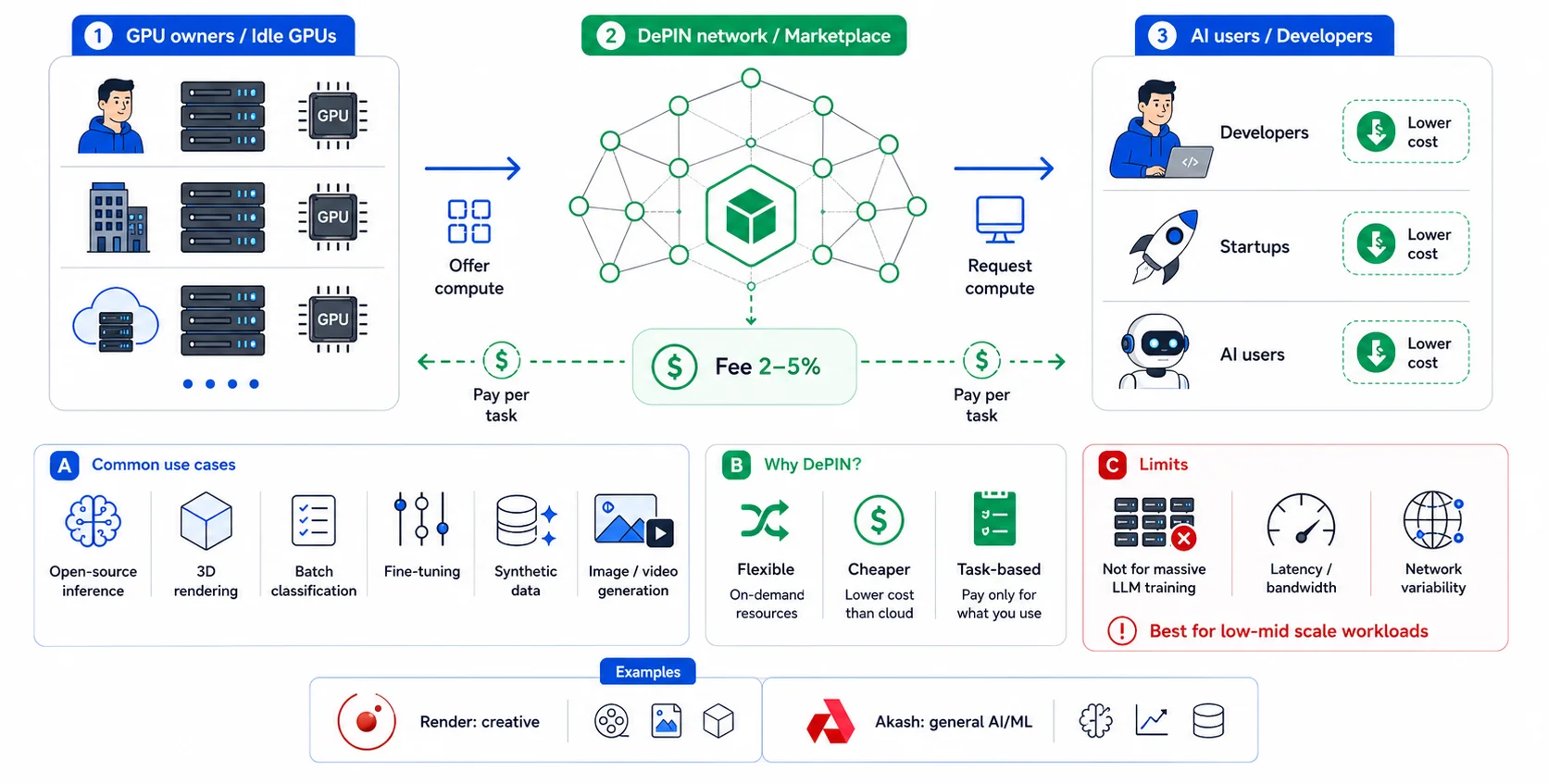
DePIN networks, or basically GPU rental marketplaces, are a viable solution to the problem discussed above.
The model's simple. Imagine a few people (or companies) who own very powerful GPUs that are idle. The network lets them rent out these GPUs to those in need for any kind of AI work in exchange for money.
The flow's basic:
-
Hardware's handled by GPU owners
-
They've devs who rent GPU power
-
After paying a small fee to the network, the owners earn money from renting
-
The buying customers get the computing power without paying big bucks to the Cloud moguls.
Render Network and Akash are two widely circulated names in this space.
While Render specifically rents compute to those in the creative industry (think people into 3D rendering, motion graphics, and visuals), Akash is an open market that leases in a permissionless way to anyone and everyone for general purpose AI/ML work.
For tasks related to AI inference using open source models, 3D rendering, batch classification, model fine-tuning, synthetic bulk data generation, and video or image generation, the DePIN model comes in very handy because it's simply cheaper. It's also viable cause most often buyers don’t actually even require the enterprise cloud packages' full capacity. So, for specific task-based usage, DePIN provides them with either GPU or CPU workability.
But there's a limit: DePIN isn't ideal for training the largest LLMs from scratch.
It's cause these LLMs need thousands (or even tens of thousands) of GPUs working very cohesively, exchanging data, with a much, much faster throughput. The more distributed the GPU networks or locations are, the greater the increase in latency and bandwidth, which later becomes a problem. The overall training becomes slower, more expensive, and tbh…not practical.
In essence, DePIN doesn’t replace hyperscalers fully as of now. It’s only meant for flexible, low- to mid-scale AI workloads.
Solution #2: Autonomous agents and on-chain settlement
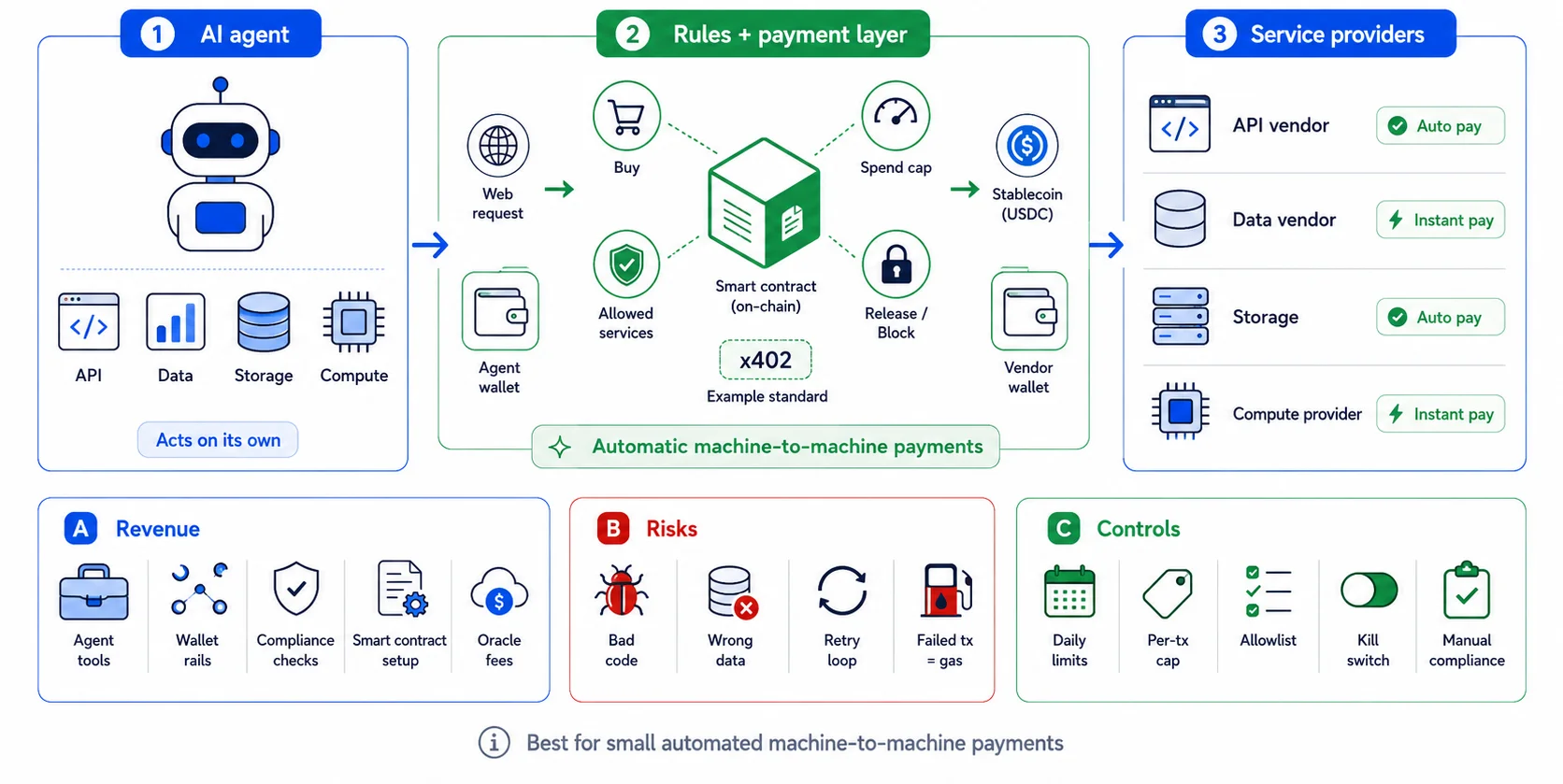
Basically, making an AI agent to pay on its own without you having to look over it. Agents aren’t just chatbots. They can be used for actions like API calling, data purchase, paying for storage, renting computers, and these kinds of small tasks.
Conventional payment systems are human-centered only. Card payments require someone to manually input the card number and CVV before making even a small $5 payment. But blockchain allows agents to automate this process.
Just create a smart contract and set the rules, rules like:
-
What the AI agent can buy
-
How much can it spend
-
Services it can use
-
When should the payment be released/blocked
The x402 protocol is a big one here, which you can use to integrate web requests into automatic payments without you having to click “pay.”
Chances of revenue generation here…well, I can think of a few.
For example, companies can make money building tools or AI agents that can process wallets, stablecoin payments, check payment legalities, or for identity verification. They can also charge for creating those smart contract-based payment rule automations and later on sell this data to bigger companies that have expertise in creating more expert agents. Apart from that, Oracle services that fetch real-time information (like prices, weather, etc) within smart contracts can earn fees for pushing them inside.
But, but, but…this entire logic of machine-to-machine economy, where the AI decides, blockchain records the execution, and the task output slash action is done, holds variable risks.
What if the AI agent’s code is bad?
What if it keeps buying the wrong data?
Or gets stuck in a loop of trying the same failed transaction again and again, or trying to call an API for which the service was never registered?
When blockchain comes into the picture, although the task fails, the gas fee rises.
Designing the budget is the answer here. Setting daily limits, caps on every transaction, keeping the contracts allowlisted, and creating a kill switch keep the risks in control.
Also, vetting compliance manually is a mandate. Checking for sanction checks, business identity checks, license proofs, etc., keeps the entire system rule-compliant instead of increasing the chances of it being an AI gone rogue story.
Solution #3: Data provenance using tokenised AI inputs
The third way is to run monetization on verified data.
Simply explained, companies like OpenAI, Google, and Anthropic basically need data for training their models, but sadly, they can't scrape the open web as freely as they could do earlier. Research firms, publishers, exchanges, media platforms, and marketplaces are learning to archive and gatekeep their information.
Blockchain comes onto the scene as the audit system here…keeping tabs on the dataset proof, licenses, alterations, and info about contributors.
The raw off-chain data is connected to a cryptographic hash that’s stored on-chain. It verifies the dataset version. The digital credential helps keep a check on who gets access. Smart contracts manage licensing, payments, and other aspects.
Finally, everything about who’s to be paid and who used the data stays logged, so there’s always something one can go back to if something needs checking.
A few of the key players in this space whom I can name right now are:
-
Filecoin for decentralized storage,
-
Chainlink for pulling in data within smart contracts,
-
NEAR Protocol and Fetch.ai for AI agent support, coordination, and AI blockchain workflows.
The murky layer here is that the same protection layer can also be used for deepfaking. Blockchain can't tell if an image or video is fake. It only records the first version of the file, tracks changes, and logs ownership history. The proof stays there, but it's for the company's legal teams, brands, and all humans in the loop to maintain the authenticity and legality of the content.
When does the AI and Web3 combo equal money lost?
It happens when the blockchain layer is added just for the gimmick of it, and it holds no specific utility.
For example, a very small model or private chatbot doesn't need each of its prompts to be recorded on-chain. Similarly, a small AI tool created for very specific tasks of file sharing and editing doesn't need token-based governance. Apart from that, recording every AI output on Layer 1 or using them as maybe NFTs and keeping everything on-chain is basically a bad idea.
Other backlogs include:
-
blockchain settlements are slower than normal cloud processing,
-
Gas fees are rising despite layer 2 making them cheaper when every AI action is considered as a transaction on-chain.
What should investors ultimately look for?
A better pattern. A smarter combo of off-chain storage and on-chain proofing (only when needed). Chain capabilities are used only when access, control, provenance, and payment are conjoint.
If you’re an investor looking to put your money in the next most resource-efficient AI, ask these questions:
-
How cheap is the compute?
-
Is there really a product-market fit?
-
Is there a liquid market for the data?
-
Is payment automation possible, and if yes, then is it controlled?
-
Is revenue sharing possible between multiple contributors?
If the answer to all these is a YES. Congrats, you’ve got yourself something of substance that can stand strong amidst the cloud computing giants.
The winner won’t compete against them in the mainstream. It’ll instead profit and function for its own user base, who are frustrated with the legacy cloud compute expenses and rigidity.
Comments
Log in to post a comment
No comments yet
Be the first to share your thoughts!
